
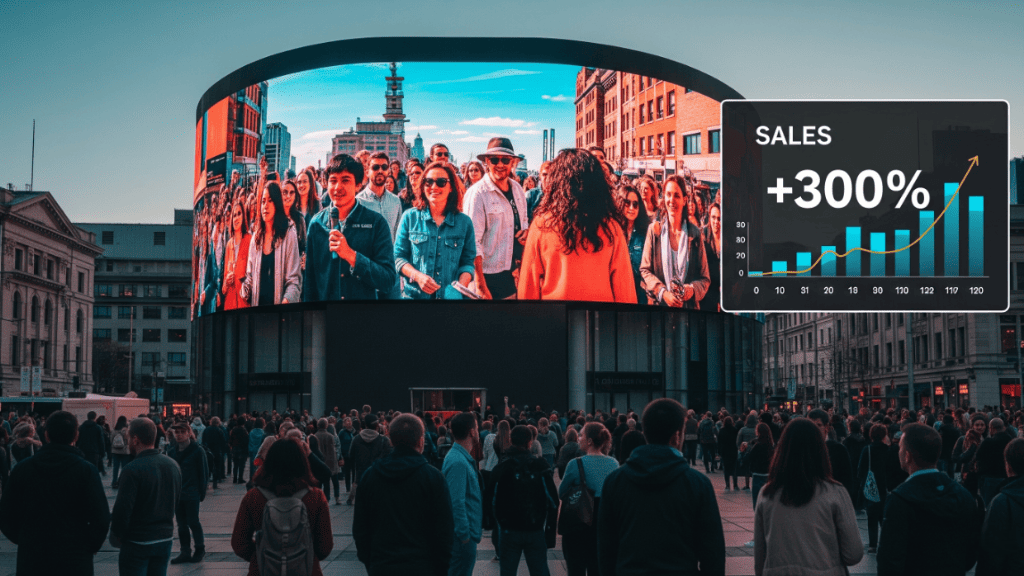
If you enjoy traveling, chances are you have seen large interactive screens installed along busy roads or near traffic lights. These large digital displays usually present public information, ranging from business promotions to government public service announcements.
Through these screens, audiences can enjoy promotional or educational content featuring integrated multimedia elements such as text, images, videos, animations, and audio, all displayed in a single, powerful visual format. These large interactive screens are known as videotrons.
In this article, we will explain what a videotron is, explore its key benefits for businesses, and review the different types you should know. Let’s dive in.
What Is a Videotron?
A videotron is a large LED display used to present visual content directly to the public in strategic, high-traffic locations. Videotrons are commonly found in major cities, especially in areas with heavy pedestrian and vehicle flow.
Typical locations include main roads near traffic lights, shopping malls, skyscrapers, and even mobile installations mounted on vehicles, often referred to as mobile videotrons.
Read Also: How Much Does a Videotron Cost? Here’s the Complete Explanation
The visual content displayed on videotrons can be static or interactive, depending on the needs of the advertiser or organization using the screen. Content formats and schedules are usually customized based on campaign objectives.
Benefits of Videotron Advertising for Business

Ambuh Marketing with Videotron (Image Source: stories.briefer.id)
Videotrons offer a wide range of advantages for businesses seeking high-impact outdoor advertising.
Read Also: Why 3D LED Advertising Is Becoming an OOH Trend: Key Benefits for Brands
In general, the benefits of videotrons can be grouped into five key areas:
1. Enhances Visual Appeal
One of the main benefits of using videotrons for business is their ability to significantly enhance visual appeal. Videotrons deliver bold, eye-catching visuals with high brightness and clarity, making images, videos, animations, and text visible even from long distances.
This is why videotrons are frequently used to promote concerts, exhibitions, and large-scale events. Their strategic placement forces attention and increases message recall, helping audiences remember the brand more effectively.
2. Supports Ambush Marketing Strategies
Ambush marketing is a strategy where a brand leverages the momentum of a competitor’s campaign or sponsored event to gain public attention without being an official sponsor. When executed properly, this approach can dramatically boost brand awareness with relatively low investment.
There are various ambush marketing tactics, including predatory ambushing, coattail ambushing, guerrilla marketing, and self-ambushing. While this strategy carries certain legal risks, many businesses find the potential exposure well worth the trade-off.
3. Makes Advertising Messages More Memorable
Another key advantage of videotron advertising is its ability to make messages more memorable. When placed in strategic locations with high traffic volume, videotrons repeatedly expose audiences to the same content.
Over time, even those who initially ignore the ad may begin to recognize and remember it. In some cases, videotrons even become meeting points or landmarks. The impact is even greater when the visuals are compelling and the ad copy is strong and engaging.
4. Reduces Content Monitoring and Update Effort
Videotrons also offer efficiency in content management and monitoring. Unlike social media or website-based digital marketing, which requires constant performance tracking, algorithm monitoring, and frequent content updates, videotron content is relatively stable.
Advertising content can be planned in advance and displayed over a fixed period without frequent changes. This allows businesses to focus more on message quality and visual storytelling rather than chasing fast-changing digital trends.
5. Creates a Strong Professional and Modern Brand Image
Using videotrons conveys a strong sense of professionalism and modernity. Large LED screens with clean, dynamic visuals reflect a brand’s readiness and seriousness in communicating with its audience.
This is why many major corporations, well-known brands, and government institutions rely on videotrons as a primary communication medium in public spaces. Videotrons enhance credibility, structure, and brand prestige, leaving a positive impression on viewers.
Types of Videotrons You Should Know
Videotrons can be classified into several categories, including:
- Size
- Shape
- Resolution
- Usage
- Installation
- LED Type
Videotron Types Based on Size
Based on size, videotrons are generally divided into three categories: small, medium, and large. The size selection depends on viewing distance and installation location.
Common videotron sizes include:
- Small size: approximately 1 x 1 meter
- Medium size: approximately 2 x 3 meters
- Large size: above 8 x 10 meters
Videotron Types Based on Shape
Videotrons are highly flexible in shape and can be customized to match visual concepts or architectural designs. Common shapes include:
- Square
- Rectangle
- Circular
- Custom shapes
In addition to flat screens, curved and flexible videotrons are also available, creating more immersive and unique visual experiences.
Videotron Types Based on Resolution
Resolution determines image clarity. The higher the resolution, the sharper the displayed visuals.
Common videotron resolutions include:
- HD: 1280 x 720 pixels
- Full HD: 1920 x 1080 pixels
- 4K: 3840 x 2160 pixels
Videotron Types Based on Usage
Based on usage, videotrons are divided into two main categories:
- Indoor videotron, installed inside buildings such as malls or offices
- Outdoor videotron, installed in open areas such as roadsides and public spaces
Outdoor videotrons typically feature higher specifications, including waterproof screens and high brightness levels to ensure visibility under direct sunlight.
Videotron Types Based on Installation
Videotrons can also be categorized by installation method:
- Fixed installation, permanently installed and non-movable
- Portable or mobile, easy to move and relocate
- Mobile videotron, installed on vehicle bodies and able to move flexibly between locations
Videotron Types Based on LED Technology
Videotrons generally use two types of LED technology:
- SMD (Surface Mount Device), smaller LED size, more energy-efficient, commonly used for indoor videotrons
- DIP (Dual In-Line Package), larger LEDs with economical pricing, widely used for outdoor videotrons
Frequently Asked Questions
- What is the main difference between videotrons and conventional outdoor advertising? Videotrons display dynamic digital content such as videos and animations, making them more engaging than static media like banners or billboards. In addition, videotron content can be updated remotely without replacing physical materials.
- Are videotrons only suitable for large companies? No. Videotrons can be used by businesses of all sizes, from small and medium enterprises to large corporations. With the right size, location, and display duration, videotrons remain cost-effective for building brand awareness.
- How do I choose the right type of videotron for my business? The right videotron depends on campaign goals, installation location, audience viewing distance, and environmental conditions. Factors such as screen size, resolution, indoor or outdoor use, and installation method should be carefully considered to ensure optimal message delivery.
Conclusion
That concludes our complete explanation of what a videotron is and how it benefits businesses. We hope this article provides valuable insights for your marketing strategy.
Get the best videotron pricing and personalized location strategy tailored specifically to your business needs. Contact the Rebound Ads Team today and launch an advertising campaign that delivers real impact.
